Purpose of the Workshop
This workshop gives the EPIC Administrators an opportunity to present their EPIC 5 Investment Plans and discuss how their proposed Strategic Initiatives, associated Research Topic Areas (RTAs), and proposed budgets achieve the Strategic Objectives approved by the CPUC in D.26-02-037. Participants will be able to ask questions and provide feedback on the proposed EPIC investment portfolios.
About the EPIC Program
The Electric Program Investment Charge (EPIC) supports the development of new, emerging, and pre-commercial clean energy innovations in California. The CPUC requires that EPIC portfolios be designed to demonstrate ratepayer benefits in the form of equitable access to safe, affordable, reliable, and environmentally sustainable energy for electricity ratepayers. This program is funded by California utility customers under the auspices of the CPUC. EPIC funds are currently administered by the California Energy Commission (CEC), which administers 80% of EPIC funds, and Pacific Gas and Electric (PG&E), Southern California Edison (SCE), and San Diego Gas & Electric (SDG&E), which together administer the remaining 20%.
Strategic Goals & Objectives Process
In its most recent EPIC Decision, D.26-02-037, the CPUC adopted a set of 13 Strategic Objectives for the EPIC 5 Investment period (2026–2030) to serve as clear, measurable, and robust targets guiding EPIC 5 investment plan strategies to scale and deploy innovation. The Strategic Objectives support EPIC's Strategic Goals, adopted in D.24-03-007, of Transportation Electrification, Distributed Energy Resource Integration, Building Decarbonization, Achieving 100 Percent Net-Zero Carbon Emissions and the Coordinated Role of Gas, and Climate Adaptation. More details on the adopted Strategic Objectives and Strategic Goals can be found on the EPIC 5 page.
The five goals guiding EPIC 5
Adopted March 2024 (D.24-03-007), these goals frame every EPIC investment plan strategy.
Climate Adaptation
Cost-effective, targeted research to improve grid resiliency and stability for ESJ and tribal communities during severe weather events, hardening the grid and reducing the frequency and duration of long outages.
Transportation Electrification
RD&D that supports planning, integration, scaling, and commercialization of innovation promoting 100% ZEV new car sales by 2035 and reducing pollution in disadvantaged and non-attainment communities.
Distributed Energy Resource Integration
Cost-effective integration of high penetrations of distributed energy resources supporting a renewable, zero-carbon power sector by 2045, including 7,000 MW of flexible load by 2030.
Building Decarbonization
Rapid acceleration of cost-effective, equitable building decarbonization technologies to help California reach carbon neutrality by 2045, including a 3% (3.6% for affordable housing) annual electrification retrofit rate.
Net-Zero Carbon & Coordinated Role of Gas
Identifying cost-effective opportunities for the "last 10%" of economy-wide carbon neutrality by 2045 through California-specific strategies for hard-to-decarbonize sectors.
13 Strategic Objectives
Strategic Objectives are clear, measurable, robust targets that (1) address key gaps in critical pathways to California's climate goals, (2) focus on the unique role of ratepayer-funded RD&D, and (3) reflect the equity, emerging-strategy, and safety principles endorsed in D.24-03-007.
Use the filters below to see which workshop day covers each objective.
Reducing Medium and Heavy-Duty Vehicle Charging Infrastructure Costs
The EPIC program will accelerate innovation, demonstration, and innovative approaches to deployment that support the reduction of the IOU cost of medium- and heavy-duty charging infrastructure installations, and associated IOU cost of grid upgrades by a stretch goal of 50% by 2035 to achieve the state’s transportation electrification goals in a cost-effective manner.
Overcoming Barriers to EV Benefits in DVCs
The EPIC program will accelerate innovation, demonstration, and innovative approaches to deployment to overcome obstacles to equitable transportation electrification benefits (including alleviation of pollution, bridging transportation access, and addressing energy burden) in Disadvantaged and Vulnerable Communities, low-income communities, and non-attainment air districts.
Smart Planning Tools for New Load and Clean Resources
The EPIC program will support the development, integration, and updating of transparent, open-access grid planning tools that a) substantially increase the forecasting and predictability of intermittent resources, electric vehicles, building electrification, flexible load, and distributed energy resources, b) enable widespread adoption of demand flexibility, c) provide transparent and coordinated inputs into utility capital planning processes, and/or d) inform utility operations for the enablement of grid services and dynamic operation with the goal of reducing ratepayer costs over time and ensuring Disadvantaged and Vulnerable Communities are not left behind in benefits from the transition to zero-emission technologies.
Reducing Cost of Whole Home Electrification
The EPIC program will accelerate innovation, demonstration, and reliable and scalable approaches to deployment that help reduce the all-in cost of whole-home electrification and enable demand flexibility / automated response to process signals or dynamic rates for single-family and multi-family buildings and manufactured housing by 50%, while decreasing residents’ energy costs, by 2035.
Innovative Approaches for Difficult-to-Decarbonize Sectors
The EPIC program will accelerate innovative approaches, strategies, and business models to achieve lifecycle cost-parity for difficult-to-decarbonize commercial and industrial buildings and processes, with a specific focus on strategies that lead to the reduction of NOx, PM, and other surface-level pollutants impacting Disadvantaged and Vulnerable Communities.
Community-Scale Decarbonization
The Strategic Objective for EPIC that the program demonstrates technology, tools, deployment strategies, planning approaches and business models for achieving (100 percent) neighborhood- or community-scale electrification that considers the needs of participating and non-participating customers, and with a prioritization on addressing needs and obstacles of Disadvantaged and Vulnerable Communities.
Impacts Research for New Generation and Storage
The EPIC program will conduct new lifecycle and techno-economic analysis, as needed, to identify the emerging zero-carbon technologies with the lowest adverse and highest beneficial economic, land, air, water, net energy, health, and safety impacts on California communities, including DVCs.
Increase Predictability of Weather Impact on, Intermittent Resources, Climate Risks, and Load
By 2030, the EPIC program will conduct data analysis and develop and/or advance data resources, modeling tools, and technologies to measurably improve: a) predictions to electric system operational climate risk; b) intermittent electric resource supply forecasts and electricity demand forecasts under climate uncertainty; c) open-access data on grid equipment condition and capability; and d) coordination between weather and climate observation/projections, forecasting, and grid operations.
Leveraging DERs for Grid and Community Resiliency
The EPIC Program will support technology development, innovative deployment models, and real-world testing and evaluation for the demonstration of the use of clean distributed energy resources to reduce the impact of outage events, through strategies that allow critical and/or essential loads and services to remain powered through such events and that reduce power restoration time for vulnerable populations, with a specific focus on solving challenges related to critical loads and services identified by Disadvantaged and Vulnerable Communities as critical community resilience needs.
Expediting and Streamlining Interconnection and Energization Processes
The EPIC Program will support acceleration of the development, testing, and integration of innovative technology, communication protocols, and modeling approaches to streamlining interconnection and energization processes for DER and new load including electric vehicle charging infrastructure, with a goal to demonstrate the capability to significantly reduce interconnection and energization approval or online timelines under multiple high DER penetration and electrification scenarios, with a priority for addressing challenges in Disadvantaged and Vulnerable Communities.
Providing Data Input into a Value of DER Framework
The EPIC Program will conduct analysis, real-world demonstrations, and data collection to support the development and ongoing update of an evidence-based framework for the location-, time-, and performance-based values of grid services that are a) usable by grid operators to reduce costs to ratepayers and expand opportunities for distributed zero-emission technologies, and b) accessible by any DER, electric vehicle, or flexible load.
Optimizing Feeder / Circuit Operations
To support ratepayer affordability, the EPIC Program will accelerate innovation, demonstration, and deployment of innovative and replicable methods to increase the capacity utilization rate of circuits/feeders and reduce circuit and feeder peak loads, and/or dynamically optimize other feeder/circuit operations in order to avoid or defer costly grid upgrades, through the coordination of DERs, EVs, flexible load, and grid intelligence, with a focus on circuits serving Disadvantaged and Vulnerable Communities where increased adoption of zero-emission technologies can increase equitable benefits.
Cost-Effective Grid Hardening for Long-Term Climate Impacts
By 2033, the EPIC program will develop and demonstrate data, tools, technologies, and frameworks that improve long-term planning and achieve more cost-effective operational practices and capital investments for grid hardening to maintain grid resilience and reliability to long-term climate impacts, with a focus on increasing affordability, reducing outage risk, and reducing social burdens of outages.
Administrator Investment Plans
The four EPIC Administrators filed their EPIC 5 Investment Plans with the CPUC, identifying proposed Strategic Initiatives and Research Topic Areas (RTAs) for the 2026–2030 investment period. Each plan must produce measurable progress toward the CPUC-approved Strategic Objectives.
Workshop Agenda
The Accelerate Group, as EPIC Policy + Innovation Coordination Group Project Coordinator, will facilitate the workshop under the guidance of CPUC's Energy Division. Select a day below to see its schedule, or add it straight to your calendar.
Day 1 Recording & Materials
Missed Day 1, or want to revisit a session? Watch the full recording or download the workshop overview presentation.
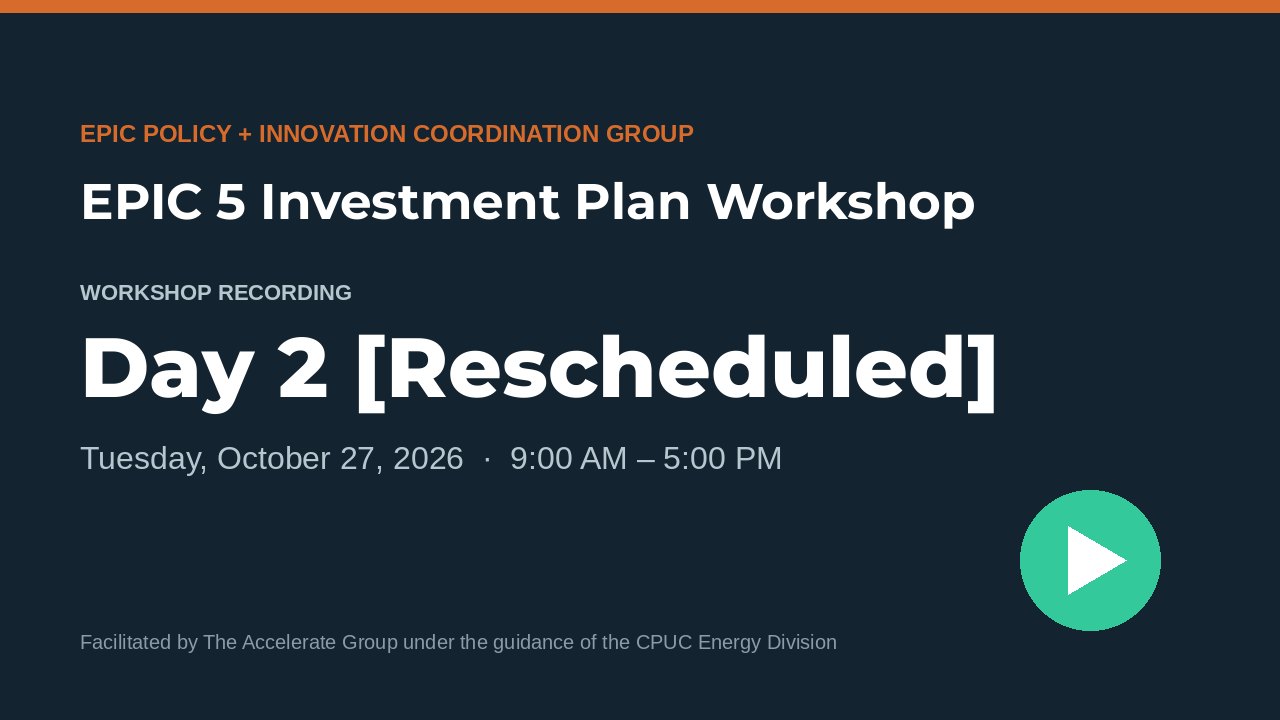
Day 2 Recording & Materials
Missed Day 2, or want to revisit a session? Watch the full recording or download the workshop overview presentation.
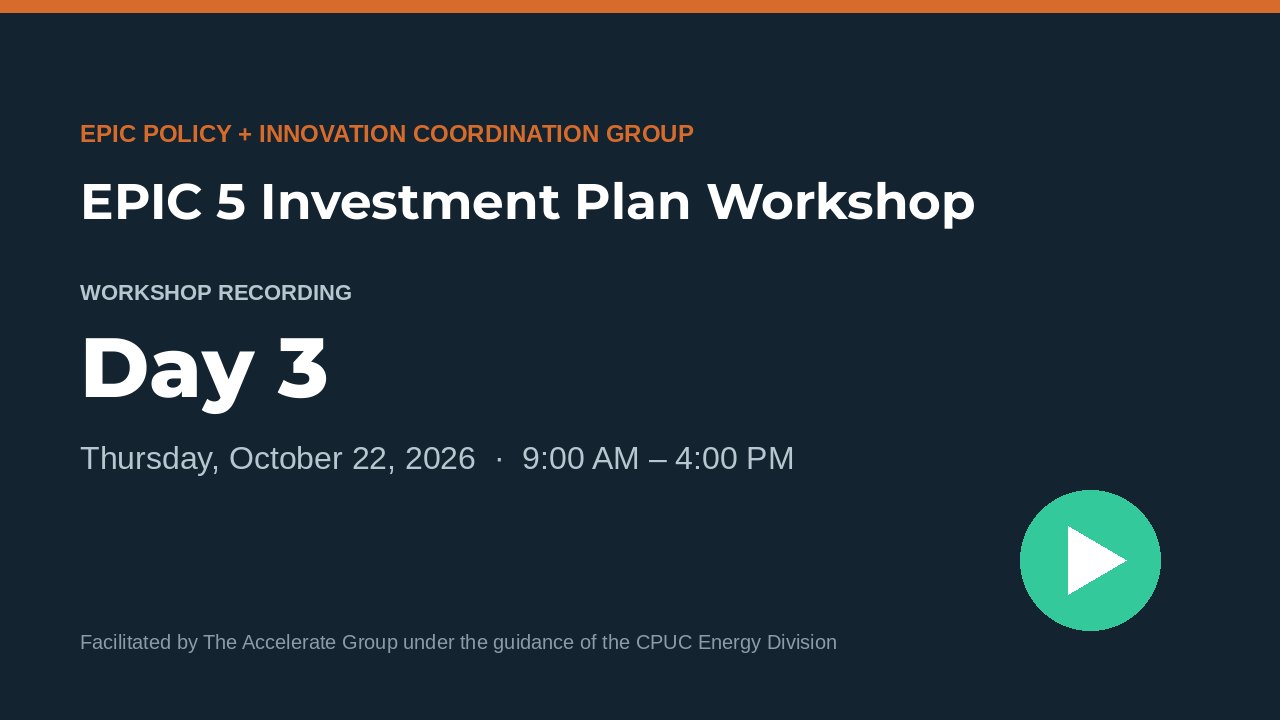
Day 3 Recording & Materials
Missed Day 3, or want to revisit a session? Watch the full recording or download the workshop overview presentation.
CPUC Auditorium
505 Van Ness Avenue, San Francisco, CA 94102. A virtual attendance option is also available for all three days.
Public Webinar Recordings
All three days of the workshop were recorded. Missed a day, or want to revisit a session? Watch the recording or watch again below, and download the workshop overview presentation.
Workshop Overview (PDF)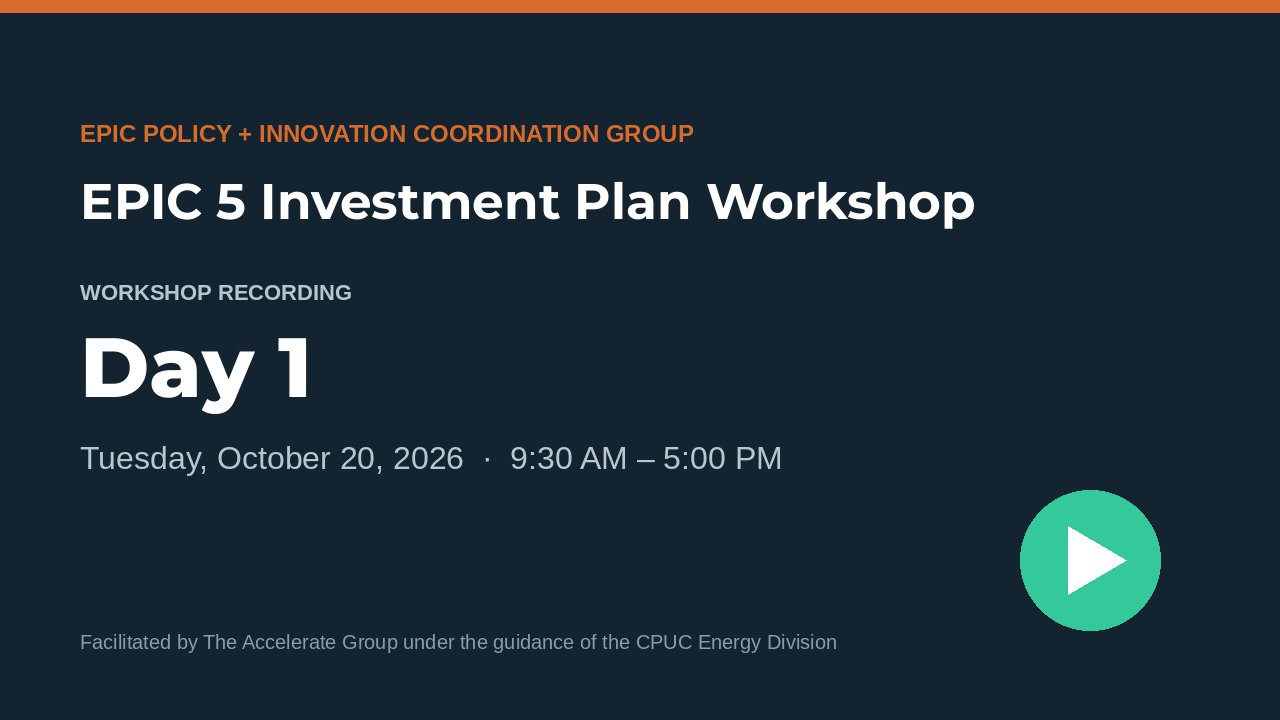
Ex Parte & Regulatory Notice
This program is funded by California utility customers under the auspices of the California Public Utilities Commission.
This notice was sent to service lists A.21-11-021, A.22-10-001, A.22-10-002, A.22-10-003, R.11-05-005, R.15-05-006, R.17-07-007, R.18-03-011, R.18-04-019, R.18-07-006, R.18-10-007, R.18-12-005, R.18-12-006, R.19-01-011, R.19-09-009, R.19-10-005, R.20-01-007, R.20-05-003, R.20-11-003, R.21-06-017, R.21-10-002, R.21-11-014, R.22-07-005, R.22-11-013, R.23-12-008, and R.24-01-017. If workshop participants discuss any open proceedings that were not noticed, then any such discussions become ex parte communications, and must be noticed to the open proceeding according to Rule 8.4. This notice is issued pursuant to Rule 8.1 of the Commission's Rules of Practice and Procedure, which states that an ex parte communication means a written or oral communication that "does not occur in a public hearing, workshop, or other public forum, that has been noticed to the official service list or on the record of the proceeding." One or more CPUC or CEC Commissioners and Advisors, and Administrative Law Judges may attend, but no official Commission action will be taken at this event.
Subscribe to the PICG Email List
Want to keep track of the progress of the EPIC Policy + Innovation Coordination Group? Get workshop updates, registration alerts, and program news sent directly to your inbox.